Tycho, the WNDSN Calculator Site, Now Answers Scripts and Spreadsheets
BERLIN, 2026-11-24 -- Every calculator on tycho.wndsn.com now answers as data as well as a page. WNDSN has published the Tycho API, which lets a script or a spreadsheet ask the same questions a visitor asks in the browser, along with wndsn-tycho, a Python package that sends those questions and reads the answers. No key or account is needed.
Tycho is the set of calculators WNDSN keeps next to its instruments. They work out what the instruments read by hand: the Sun and the Moon, the stars, sight reduction, range, elevation, the dipping distance of a lighthouse, map scale, the shadow square, and the CCT and Duv of a light source. People use them to plan a measurement, to practice before going out, and to check a reading afterwards. Until now that meant one calculation at a time on the screen.
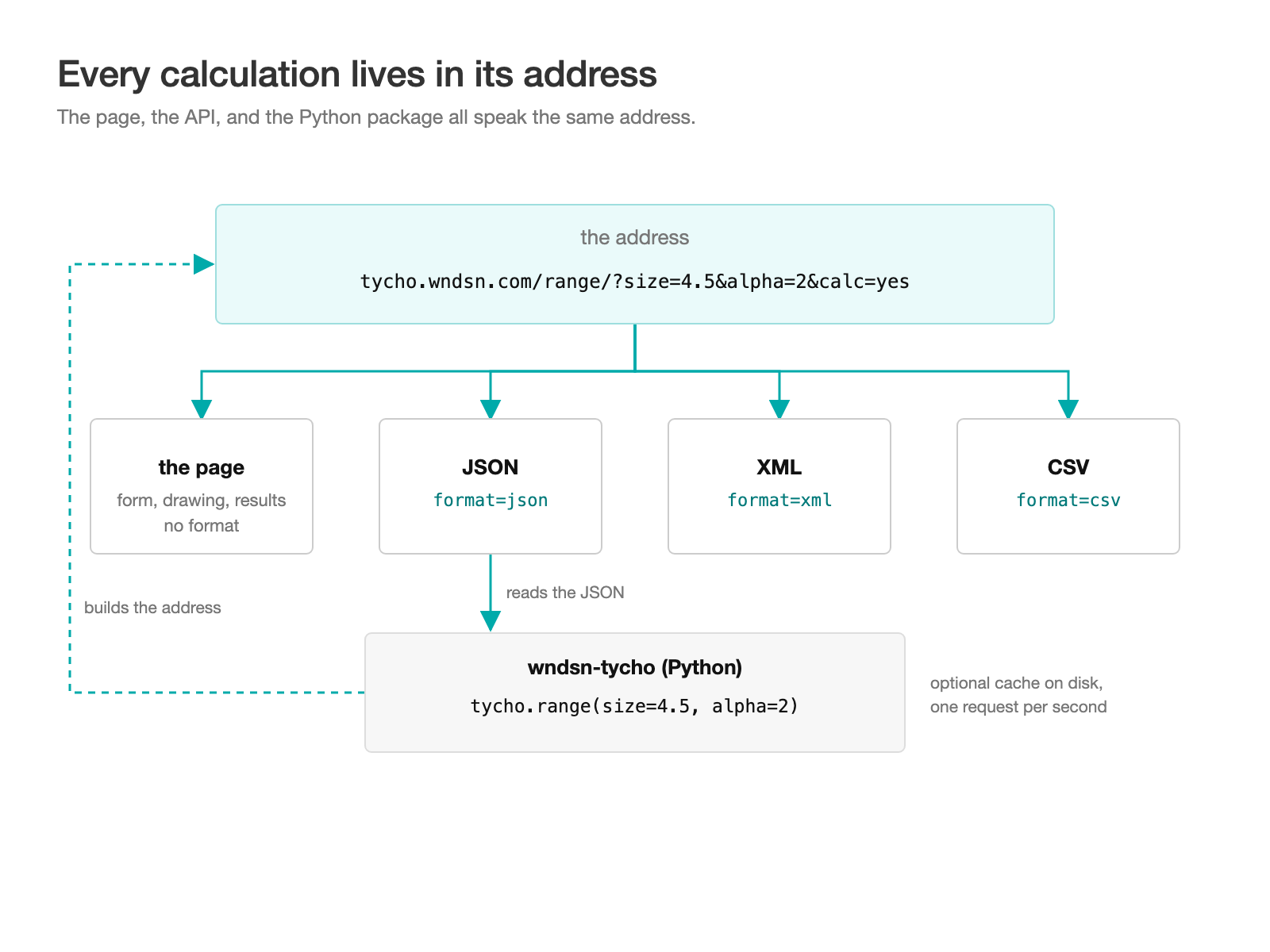
The API changes nothing about the pages. Each calculation already lives in its address, with the values and their units in the link, so a bookmark brings back the same result. Adding format=json to that address returns the answer as data. JSON and XML carry the same structure, and CSV returns one header line and one row, so the rows of many queries stack into a single table. Each answer repeats what was given under input and lists the results under output. When something was wrong with the input, notes explain it in plain English. A value that does not exist, such as sunrise during the polar day, comes back empty.
A query for Berlin on the December solstice shows how it works:
https://tycho.wndsn.com/sun/?latitude=52.52&longitude=13.40&tz=1&date=2026-12-21&calc=yes&digits=1&format=json
Tycho answers that on December 21, 2026, the Sun rises at 08:15 and sets at 15:54 Central European Time, which leaves 7 hours and 39 minutes of daylight. At solar noon, 12:04, it stands 14.0° above the horizon. With format=csv the same address returns the same values as one row for a spreadsheet.
Tycho asks for at most one request per second. An address that gives every value gives the same answer every time, so a script can keep its answers instead of asking again. The answers are meant for servers and the command line. In a browser, only pages on tycho.wndsn.com may read them. Parameter names that were replaced over time still work, so old links and old scripts keep running.
For Python there is wndsn-tycho, installed from PyPI with pip install wndsn-tycho. It has one typed method for each calculator and checks the arguments before anything is sent, and its results come with named fields. It needs Python 3.10 or later and nothing outside the standard library. The license is MIT. The package keeps to Tycho's house rules by itself: it waits at least a second between requests and names itself in each one. An optional cache on disk lets repeated runs, and tests, work without a network. A command line tool comes with it, so wndsn-tycho sun latitude=52.52 date=2026-12-21 answers in a terminal. The current version is 0.1.0, and its source is on GitHub.
The easiest way in is a calculator page. Every result on tycho.wndsn.com links its own answer in each of the three formats under the Results heading, so a calculation on screen is already a working query to change. The API page describes the address and its answers in full, with a section on the package.
Quotes
"Our instruments work without batteries, and they will stay that way," said Alexander Becker, founder and director of WNDSN. "Tycho is for the evening after a measurement, when the readings go into a logbook or a spreadsheet. Now a script can ask the same question the page answers, and it gets the same number back."
Discover More
- https://tycho.wndsn.com/api/
- https://tycho.wndsn.com/
- https://pypi.org/project/wndsn-tycho/
- https://github.com/gqt0/wndsn-tycho
Photos:
About WNDSN
Founded in 2014, WNDSN's Applied Science Lab in Berlin develops and manufactures low-tech, high-utility instruments for measuring and navigating in the field. Its Telemeters, quadrants, map rulers, and protractors are engraved and cut in Germany. They need neither batteries nor a signal, and they are built to provide "that, which can’t be improvised" where electronic devices are unavailable or not permitted. The Telemeter nomograph is an original WNDSN development. All work follows the motto "Ex Mensura, Scientia" -- knowledge from measurement.
Mission
WNDSN [ˈwɪndsən] provides knowledge and tools for educating and training professionals and enthusiasts in the mastery of time and space. Its instruments measure values in the real world, and its manuals and courses teach how to compute meaningful results from those values by hand and how to put them to use in the field.
Products and Learning
WNDSN produces archival quality instruments that combine techniques proven over centuries with contemporary methods, in the spirit of the Renaissance. Some are made to order, such as the Custom Astronomical Quadrant, which is engraved for the buyer's latitude. The documentation is available in English and German: the field manual GQT6 and the short mini-courses teach the use of the instruments, and the WndsnVFX channel on YouTube shows them at work. The online calculators at tycho.wndsn.com help plan a measurement and check its result, and they answer in machine-readable formats for anyone who wants to build on them. Instruments and courses are sold at store.wndsn.com in English and German, and GQT6 is available on Amazon.